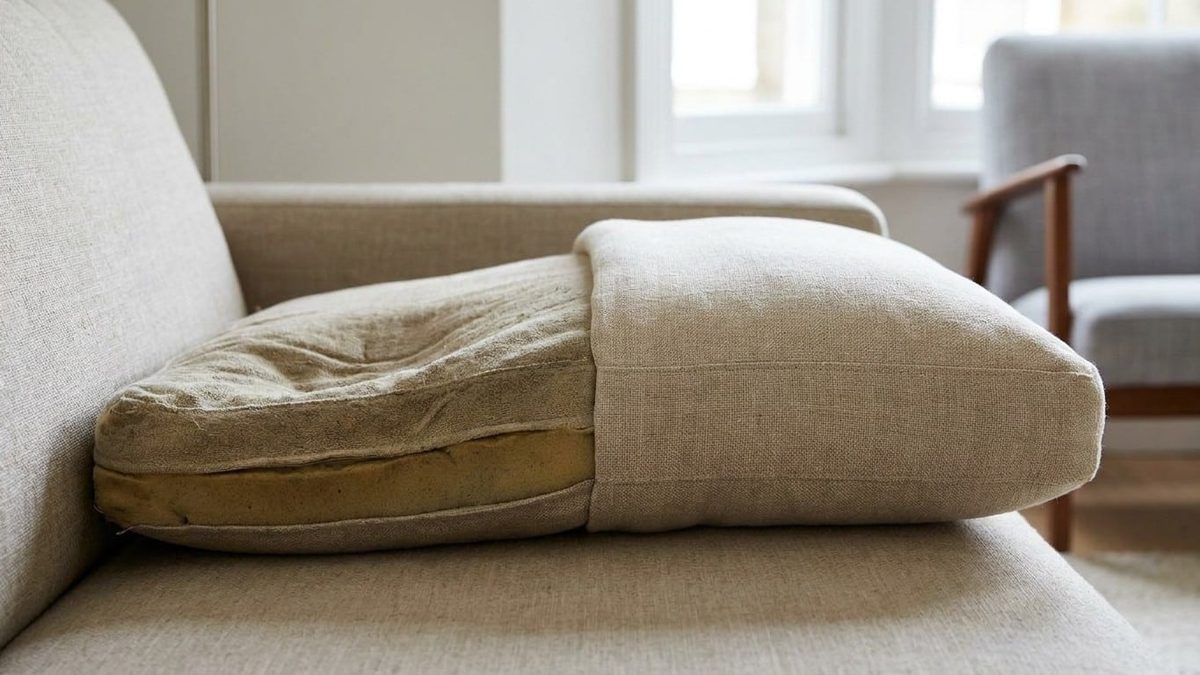
It took me six years to realize that my favorite seat cushion no longer looked like a rectangular piece of foam. It looked like a ghost of my body.
The day I finally turned it around, the difference was amazing. One side was flat and pressed into a permanent depression. The other side was still round, as if it had never supported a person.
Key Takeaway: If the foam is compressed in the same place for years, it will not return to its original shape. Just turning the cushions weekly makes a difference. The density of the foam at the time of purchase determines whether your sofa will last 3 years or 15 years.
Зміст
Asymmetrical Wear Phenomenon
That day I was looking at a particular type of furniture decay called asymmetric wear. If you sit in the same position, the pressure is always concentrated on one part of the cushion and the rest does not change much. These two factors work together to shorten the life of your furniture.
My sofa has not aged evenly after more than 6 years. I’ve been using it for 6 years and it was always centered in the 40-square-centimeter zone where my weight rests.
The rest of the cushion was barely alive.
Why Foam Never Bounces Back
The cushioning foam acts like a network of thousands of small bubbles. It collapses slightly with each squeeze and springs back into shape with each release.
However, this cycle has its limits. Cushion sagging is primarily related to the repetitive stress we experience in our daily lives. When a certain threshold is exceeded, the cells stop recovering.
This is what manufacturers call a “compression set” and is a permanent deformation of the internal structure. Once installed, it cannot be removed.
One industry expert summed up this logic well: Low-density, low-quality foams settle quickly, while High-density foams can retain hardness and elasticity longer.
The Backrest Follows Without Notice
I also didn’t notice a different but related pressure in the backrest of the sofa. Seat cushions bear the weight of your body directly, so they tend to sag faster than backrest cushions.
Over time, however, the backrest compensates for the sagging of the seat by taking an abnormal angle. The body calms down in different ways and the stress moves to new areas that it has never asked for before.
As a result, the two cushions on the sofa look symmetrical from a distance, even though they have been used in completely different ways.
Few people have this habit
Furniture experts have been repeating this approach for years, apparently without much success. Ideally, the seat and backrest should be changed every few weeks to distribute pressure areas.
Recent guides are also in the same direction. Rotating and changing the cushions weekly evens out the padding and prevents some areas from sagging faster than others.
Other sources talk about a bi-weekly pace instead of weekly. Regardless of the exact frequency, the principle is the same, the pressure zones are changed before fixing.
An often-overlooked additional tip: Avoiding sitting in the same place always limits not only individual cushions but also the entire sofa’s hollows.
The Number No One Checks at Purchase
The bump on the seat cushion isn’t just because of my habits. Its original foam was likely entry-level, a detail easily overlooked when buying.
Experts recommend a minimum density of 35 kg/m3 for the sofa seat, while the density of the armrests and backrest is 26-30 kg/m3. Over time, high-resilience foam will become a game changer.
Some high-end foams are very resilient foams that can last almost 12 years, Quallux foam can last 15 years, while basic infill foams can only last a few years.
What to do after damage
After six years of unilateral wear, simply turning the cushions is no longer enough to restore balance. The foam retains its memory of compression like a sponge that is compressed again and again in the same place.
However, you can be sure of one thing. A professional company will come to repair your sofa and replace the foam. The costs vary between 30-70 euros per standard foam cushion.
When faced with this figure, the cost of replacing the foam is usually much lower than replacing a whole new sofa. The next measure this time is preventive. Mark the date of the month and strategically turn each cushion over before the new hole becomes permanent.