Screws are stronger than nails and have better holding power. It can also be easily dismantled. This is a basic advantage. But how many types of screws are there?
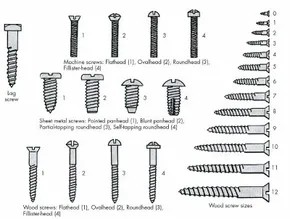
Like nails, screws also have an anti-rust coating. These fall into four basic main categories with different slot styles. Flat head screws get countersunk. The head is either flush or below the surface. The oval head screws are partially recessed. About half of its head is still above the surface. Round head screws sit perfectly above the material. Fillister head screws have a raised flat base. This prevents the screwdriver from scratching the surface during tightening.
In addition to these core types, there are several special uses. Let’s look at common home improvement options. Get tips on how to use each type in your own projects.
Зміст
Drilling Screws and Pilot Holes
Most screws have slot heads. Can be driven with a standard slotted screwdrivers. It is a Phillips head screw with a cross recess. Requires a Phillips driver.
The length and diameter of the screws are measured. Measurement numbers 0-24 are used as the diameter of the stem. Lengths are in inches. The right length is important. At least half of the screw must extend into the base material.
Drill pilot holes first to prevent the wood from splitting. A pilot hole creates a vessel. The screws go in without damaging the surrounding fibers. It saves you from ruined boards.
From wood screws to machine screws
Wood screws are sufficient for most home repairs. There are also sheet metal screws, machine screws and lag bolts. Need a replacement? Take the old screws to a hardware store. Match the old one exactly. Here are the most common types you’ll encounter.
Wood screws
These are usually made of steel. If there is a risk of corrosion, use brass, nickel, bronze or copper. For best performance, the holes must be drilled first. The pilot hole here is non-negotiable.
Sheet metal screws
Used to fasten metal parts. Forms its own thread during installation. There are two main types of panheads. Pointed pan head screws are coarse thread screws. Suitable for use on light sheet metal. Sizes vary from 4 to 14. Lengths range from 1/4 inch to 2 inches.
Blunt pan head screws handle heavier metal. They share the same gauge and length ranges. Both types have plain or Phillips-head slots.
Round Head Screws
Partial-tapping round head screws have finer threads. They work in soft or hard metals. Diameters range from 3/16″ to 1-1/4″.
Self-tapping round head screws are suitable for heavy duty work. Thick sheet metal requires them. Diameters range from 1/4 inch to 2 inches. Lengths go from 1/8 to 3/4 inch. Both types are available with plain or Phillips slots. They are the ideal choice for self-tapping jobs.
Machine Screws
These are blunt-ended. Holds metal parts together. They are usually made of steel or brass. The coating helps prevent rust. Brass, copper, nickel, zinc, cadmium and galvanized options are available.
Machine screws come in all four basic heads. Flat, oval, round, fillister. Slots are plain or Phillips. Gauges usually range from 2-12. The diameter ranges from 1/4 inch to 1/2 inch. Lengths range from 1/4 inch to 3 inches.
Lag Bolts
For light purposes, lead, plastic, or fiber plugs can be used. These are anchors. They hold screws in place. Larger jobs need more holding power. Lead expansion anchors and lag bolts step in.
These are also known as lag screws and are strong fasteners. Drive with a wrench. Used for stone and wood frames. Insert the anchor bolt into the hole drilled in the rock. Screw the lag bolt tightly onto the anchor bolt.
“Lead expansion anchors and lag bolts can be used for larger jobs and greater holding power.”
The difference between screws and bolts can sometimes be unclear. However, if you know your head type and screw pitch, you won’t get out of the hole. It also prevents you from buying the wrong box.
Which title style suits your current project? The answer depends on the surface. What next? It depends on the material.
Self-drilling screws and machine screws
No more guessing what size hole you need. Self-drilling screws combine the drill bit and the holder into one unit. I have to practice beforehand. Just drive. This saves time on metal frames and roofs where speed is critical. The fluted tip acts as a drill bit and removes material as the threads penetrate.
Machine screws are different. They don’t try to carve themselves into conifers. Requires pre-threaded holes or nuts. Hex head screws are also suitable for this. Use a wrench or socket. No need to disassemble the head to increase the torque.
Tapping screws can save time when working with fragile materials such as cast iron. It’s not just about changing materials. They cut a new thread. This prevents the delicate substrate from cracking.
Special contact method
Woodworkers know that visible hardware can ruin clean lines. Pocket hole screws solve this problem. The stem near the head is a smooth design. This allows the upper tree to slide closer to the lower tree. The slanted screw at the tip holds the base plate firmly in place.
result? A joint that pulls itself together. No clamps are needed for final tightening. The head is under water. You can add or hide them.
In mechanical applications, simply assembling objects is not enough. Accuracy is required. Threaded hole fasteners withstand vibration and load. You can choose the screws according to the strength requirements. Stainless steel is not easy to rust. Made of carbon steel and suitable for tough applications.
Choose the right tool for your job
The choice of screw determines the controller. The cross head comes off easily when high torque is applied. A Torx or square screwdriver (Robertson) provides a better grip. It won’t come out. This is important when driving long screws into hardwood or metal.
Safety is not an afterthought. Wear safety glasses. When using self-drilling screws, metal shavings can be thrown out. There was trash everywhere. When using a drill, clamp the workpiece. Do not hold it by hand.
A quick explanation of when to use what.
- Self-drilling : Pre-drilling is not required for metal-to-metal joints.
- Machine screws : Use nuts or threaded holes to connect metal to metal.
- Threads : Fragile materials, plastic or cast iron.
- Pocket holes : carpentry, hidden seams, frames.
You might think that all trash can screws can look the same. they don’t know. Results will vary depending on head style, rise and tip design. If you choose incorrectly, the thread may come out or the fabric may break. Check the specifications. Or look at the packaging. The code says it all.
Some projects require specific torque settings. A manual screwdriver gives the feeling. Shock absorbers have more power, but less maneuverability. Know your limits. If the screws resist, stop them. Check for alignment errors. Force breaks things.
Hardware stores have thousands of options. Don’t buy the first box you see. suitable material. Match the load. Adapt it to your environment.