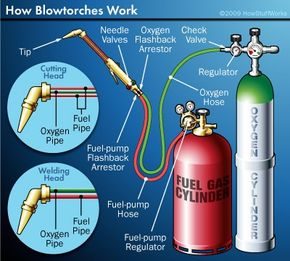
Gas blowtorches are deceptively simple machines. The basic architecture hasn’t shifted much in a hundred years. You have a fuel tank, an oxygen tank, regulators, hoses, the torch head, and a tip. That’s it. Professional units might look fancier, but the mechanics remain stubbornly consistent. Getting the components right is the only thing standing between a clean cut and a catastrophic explosion.
Зміст
Regulators Control the Pressure
The regulators screw onto the cylinder heads. Their job is to control the pressure and flow of the gas. Adjusting them to the correct pressure isn’t just a suggestion. It’s a safety requirement. Incorrect pressure invites disaster.
Each regulator features two gauges. The high-pressure gauge tells you what’s inside the tank. The low-pressure gauge shows what’s actually heading to the hose and torch. You need to monitor both. If you ignore the low-pressure reading, you’re flying blind.
Hoses and Color Codes
Steel cylinders connect to the torch via strong, flexible hoses. Rubber is the standard material. It needs to withstand heat and abrasion. But more importantly, you must never mix them up.
The color coding exists for a reason. The oxygen hose is green. The fuel-gas hose is red. If you swap them, the chemistry goes wrong. The flame won’t just be inefficient; it could be dangerous. Keep the green hose on the oxygen tank. Keep the red hose on the fuel tank.
Torch Heads and Tips
The torch head itself houses two needle valves. These are the circular knobs you turn to control flow. One knob manages oxygen. The other manages fuel gas. Precision matters here. You aren’t just turning a tap; you’re fine-tuning a reaction.
The tip attaches to the head. You swap tips based on the task. Cutting thick steel requires a different tip than heating a pipe joint. Some setups include an oxygen pipe that sends a focused stream of oxygen directly into the flame’s center. This intensifies the heat for cutting metal.
Never use a cigarette lighter or a match to ignite the torch. The temperatures involved are dangerously high. You need a dedicated igniter.
Safety Devices You Can’t Ignore
What keeps the torch from blowing up in your face? Several attachable safety devices are usually standard, but you should verify they are present. They are non-negotiable.
-
Check valves attach to the regulators and the torch head. They prevent gas from flowing backward through the hose or cylinder. The pressure in the hose must always exceed the pressure in the torch head. If that dynamic flips—if the torch head pressure surpasses the hose pressure—the check valve slams shut. It cuts off the gas supply immediately.
-
The flashback arrestor fastens to a regulator. It typically combines a check valve with a flame barrier. The barrier allows gas through but blocks flame. This prevents flashbacks. A flashback occurs when the flame travels up the hose into the cylinders. It’s a chain reaction that can lead to an explosion in the tank itself.
Ignition Methods
There are two primary ways to light a blowtorch.
- Piezoelectric igniter: Pull the trigger. A hammer strikes special crystals. The impact generates electric voltage. Sparks fly. This is the mechanism used in many modern grills and torches.
- Friction igniter: This looks like an oversized safety pin. Squeeze it. The friction scratches special crystals. Sparks result.
Both methods rely on piezoelectricity. The principle is the same. Mechanical stress creates an electrical charge. It’s a clean, reliable way to light a high-temperature flame without introducing an open source of fire to the gas line.
Understanding how these components interact isn’t just about knowledge. It’s about survival. A blowtorch is a tool that demands respect. Treat the pressure, the hoses, and the safety valves with the seriousness they deserve.