Filters do the heavy lifting for you. It removes fallen leaves and debris. But what about chemistry? This is a small adjustment. Without the right balance, your pool can become a breeding ground for problems.
Think about it. Untreated water is a breeding ground for pathogens. That’s where bacteria multiply. Diseases spread easily. But bad chemical reactions don’t just cause disease. The result may be damage to parts of the pool. May irritate skin and eyes. Clear water turns into cloudy soup.
Disinfectants are needed to stop pathogens. Chlorine is standard. It is usually available as calcium hypochlorite (solid) or sodium hypochlorite (liquid). It reacts when you drop it in water. Produces hypochlorous acid. This is a really hard worker. Corrodes bacterial cell walls. oxidizing enzymes. It destroys living beings from the inside out. Bromide works similarly, but chlorine is better.
Where to add pool chemicals for best results
Chlorine can be bought in liquid, powder and tablet form. Some professionals use gas. But where you put it matters.
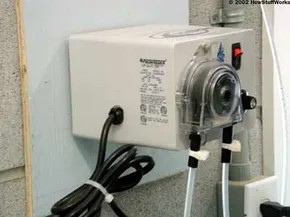
Don’t just throw the pills in the skimmer boxes. The concentration is somewhere too high. This is a uneven chemistry. Experts recommend adding chemicals immediately after the filtration process. Use chemical feeder. The dose is evenly distributed throughout the water.
Hypochlorous acid is unstable. Sunlight kills it. It breaks down under the influence of ultraviolet light. That’s why we need stabilizers. Cyanuric acid is the most common suspect. It reacts with chlorine to form compounds that resist UV damage.
But there’s a problem. Even with stabilizers, hypochlorous acid can team up with other chemicals. It binds ammonia. Where does ammonia come from? Urine. sweat. dirt.
result? Chloramines.
This is all bad news. Disinfection is also not good. May irritate the eyes. May sting the skin. It stinks. Does your pool have a strong “chlorine” smell? It’s not chlorine. This is chloramine. This means there is too little free chlorine. There is too much waste.
The solution is shock therapy. Add tons of chemicals. Blow away the organic matter. Removes unwanted compounds. Return to clean water.
Maintain proper pH
Chloramines production is directly related to another main factor, pH. If the pH is not correct, the chlorine will not work properly. It’s not just about disinfectants. It’s about the environment. Adjust the pH. Otherwise, you will lose the battle against bacteria and irritants.
Installation of pool lighting
Now let’s talk about light. Most modern swimming pools have underwater lights. Aesthetic taste? certainly. But mostly for safety. A must see for night swimmers.
The standard setting uses incandescent bulb. It is enclosed in a watertight device. The unit is located in a niche in the wall of the pool. The insulated wire enters through a special seal. This prevents water from away from conductive parts.
The wires run along long tube back to your home. The pipe is mostly full of water. However, there is slack in the wire. There is enough space to pull the entire unit out of the niche. Raise it above the water line. Replace the light bulb. Simple.
Fiber optics offer an alternative. There are no incandescent bulb in the water. Keep the light source dry. Skip the waterproof electrical issue altogether. Do not pull the device out of the niche. Just connect the fiber to the light engine. It’s cleaner. It’s safer.
But be careful. Electricity and water do not mix. If you do it yourself, respect the seal. Check the insulation. Make sure the niche is waterproof. When a leak occurs, you are in a dangerous situation.
Pool maintenance is a cycle. filter. chemicals. light. balance. If one of these parts is missing, it affects the wniche system. Keep the chemistry tight. Keep the lights sealed. Stay safe.