There is a specific kind of disillusionment that hits in mid-January. You are cozy indoors, protected from the biting cold, but your eyes keep drifting back to the living room. Specifically, the sofa. It has become the gravitational center of your home, the place for family gatherings, reading, and doing absolutely nothing. But stare at it long enough, and you stop seeing comfort. You see the faded fabric. You notice the sagging seat cushions. You realize you are sick of the color.
Do you need to drain your savings for a new, expensive piece of furniture? Is buying new the only way to fix it? Absolutely not. That path leads straight to waste and clutter. There is a smarter way to refresh a space without throwing out a perfectly good frame. It requires no power tools, no heavy lifting, and no major budget. It relies on a specific combination of textiles and a rigid rule for styling.
This approach has transformed dull living rooms into inviting sanctuaries. It works because it addresses the visual weight of the furniture rather than just hiding flaws. Here is how to execute a quick, high-impact redesign using items you likely already own or can find inexpensively.
Зміст
Camouflaging Wear with the “Thrown Blanket” Technique
Before you even touch a pillow, you must address the base. A sofa often looks old not because of its structure, but because the upholstery has lost its luster or the frame looks too rigid. The fastest fix is to use fabric to soften the lines. Think of this as “blurring” the edges of the sofa.
Do not simply fold a throw blanket neatly into a square on the backrest. That looks dated. It looks like you are saving it for later. Instead, master the art of the XXL thrown blanket. The goal is to create movement. You want the fabric to look lived-in and accidental, even if you spent ten minutes arranging it.
To get the look right, follow these steps:
- Size matters: Choose a throw that is at least 130×180 cm. Bigger is better. You want an XXL throw that drapes generously over the armrests and falls toward the floor.
- Texture is key: Avoid thin cottons. Winter demands substance. Look for chunky wool knits, boucle, or thick cotton gauze. These materials add visual warmth and hide the sofa’s underlying shape.
- Placement: Drape the throw diagonally across one armrest. Let it cascade down the seat and pool slightly on the floor. Do not strive for symmetry. The asymmetry is what makes it look stylish rather than just functional.
For color, keep it calm. You want to reduce visual noise, not add to it. Stick to neutral, soothing tones. Ecru, mineral beige, warm gray, or muted olive green work well. If you need a spark of warmth, terracotta is a strong choice. These colors distract the eye from any stains or fading on the original upholstery.
The 2+1 Rule for Cushion Styling
Once the blanket is in place, the real transformation happens with the cushions. They are the makeup of the sofa. They define the style and set the mood. Most people make the same mistake: they buy matching sets from the store, or they pile on too many random patterns. The result is usually chaotic or boring.
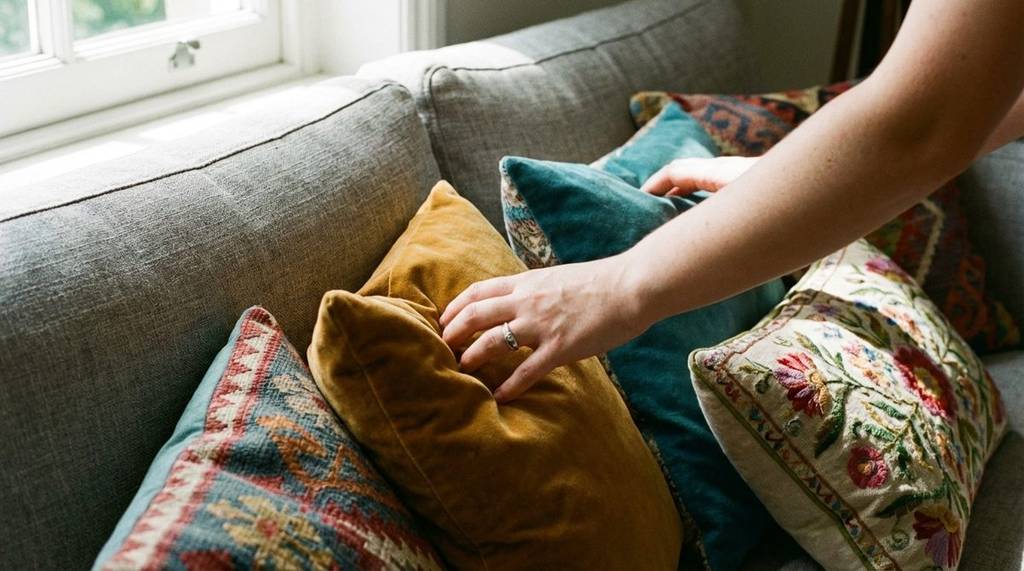
There is a proven formula that works on any sofa, regardless of its shape or size. It is simple, but it forces you to be intentional. The rule is: 2 textured solids + 1 strong pattern.
This combination balances comfort with visual interest. Here is how to apply it:
The Two Solids (The Foundation)
Choose two cushions that are solid in color but rich in texture. Skip plain cotton. Winter calls for depth. Look for corduroy velvet, thick washed linen, or boiled wool. These materials catch the light differently and feel better against the skin. These two pillows anchor the look. They provide the bulk and the comfort.
The One Pattern (The Focus)
This is the wildcard. The third pillow must contrast sharply with the solids. It can be stripes, a bold geometric print, a vintage pattern you found at a thrift store, or a subtle micro-print. This piece draws the eye. It gives the room character. Without it, the sofa might look flat. With it, the sofa looks designed.
To keep the look cohesive, limit your palette. Use a maximum of three colors across the entire grouping, including the throw blanket. This prevents the sofa from looking like a carnival. It creates a curated, magazine-worthy aesthetic.
You do not need to rip out your carpet or paint the walls to make a change. Sometimes, the problem is just that the textiles are not doing their job. By layering a large, textural throw and applying the 2+1 cushion rule, you reset the visual weight of the piece. It feels new again. It feels intentional.
The rest of the living room can wait. For now, the sofa is the stage. And with the right props, the show goes on.
Anchoring the Look with Rectangular Lumbar Pillows
Standard square cushions often feel unbalanced on large sectional sofas or bulky three-seaters. The typical trio leaves gaps, making the arrangement look sparse. You need a structural bridge. That bridge is the rectangular lumbar pillow.
Place it in the center or opposite your square set. The elongated shape breaks the rigid symmetry of squares. It adds an architectural finish. The space feels grounded, not floating.
Choose a contrasting material. If your squares are linen, go for vegan leather. Or pick a hand-woven textile. The texture difference creates depth. It signals intention, not just decoration.
The Role of Rugs in Defining Space
Your sofa doesn’t exist in a vacuum. Surroundings define its presence. A small rug anchors the seating area. It draws the eye downward.
Materials matter here. Jute, shag wool, or Berber styles work well. They soften the floor. In January, cold floors amplify the visual weight of furniture. A rug warms the space. It unifies cushions and throws into a cohesive unit.
The right rug limits the zone. It creates an enclosure. Attention shifts from the sofa’s bulk to the curated area around it.
Texture and Intention
Subtle changes yield significant results. Layering textures elevates the room. You don’t need new furniture. You need better composition.
This is interior styling. It’s about appreciating existing pieces. It’s about adding layers that reflect your taste. The goal is warmth. Cohesion. A space that feels lived-in, not staged.
What material will you introduce next?