We walk past them daily. We swat them at the picnic table. We rarely stop to consider the complex engineering beneath our feet or inside our walls. An ant colony isn’t just a line of bugs; it is a sprawling, subterranean metropolis. Tunnels branch off into rooms. The society is stratified. You have the Queen, the egg-laying engine of the entire operation. You have the workers, tirelessly foraging to feed her. Soldiers stand guard. Males exist only for reproduction. It is a machine that runs without pause.
But where exactly is this machine built?
For the homeowner, this isn’t just biology trivia. It’s a structural threat. Ants nest both outdoors and indoors, but finding the source of an infestation is harder than it looks. In theory, you should just follow the trail. In practice, those trails lead deep into the foundation, under slabs, or inside drywall. You can’t see the heart of the colony. You can only see the symptoms.
Зміст
Why Surface Nests Don’t Tell the Whole Story
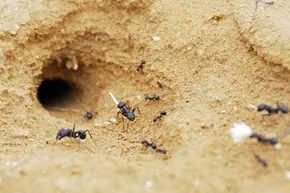
Most ant colonies live outside. If you grew up in any suburban neighborhood, you know the urge to kick over a dirt mound in the grass. It feels satisfying. It looks like you’ve won. You haven’t.
Disrupting what you see aboveground will not do much damage.
Ant nests extend far underground. The visible hill is just the tip of the iceberg. Smashing the surface entrance leaves the Queen and the brood safe in the dark. The colony simply digs a new exit. To truly manage an infestation, you need to understand what kind of builder you are dealing with. Different species have different strategies, and those strategies determine where you need to look.
The Carpenter Ant: Wood Destroyers
If you suspect a structural issue, look for carpenter ants. These are the heavy hitters. They are often mistaken for termites because both inhabit wood. The difference is critical. Termites eat the wood for nutrition. Carpenter ants do not eat the wood. They chew it to create space.
They prefer damp, compromised timber. Rotting beams. Wet foundations. Decaying window frames. By burrowing into these areas to build their nests, they cause severe structural damage. The wood remains intact on the outside but is hollowed out within. If you hear a rustling sound in the walls, or see piles of sawdust-like debris (frass) near wood structures, you are likely looking at a carpenter ant infestation.
Pavement Ants: The Concrete Crackers
Pavement ants are less dramatic but equally persistent. They set up camp at the perimeter of your home. Look along the sides of garages, near house foundations, or close to any concrete construction. They exploit the weaknesses in your home’s shell.
These ants enter through tiny cracks in basement walls or concrete floors. They slip through the gaps around basement windows and doors. In some cases, they find access points under poured concrete slabs. Once inside, they can establish satellite nests, spreading out through your foundation. If you see ants marching along baseboards or near utility lines, pavement ants are a strong candidate.
Pharaoh Ants: The Warmth Seekers
Not all ants fear the cold. Pharaoh ants are a tropical species. They cannot survive harsh winter months outdoors. This limitation has driven them indoors, where they have migrated across the United States, even in colder climates.
They have adapted by nesting inside the warmth of your home’s structure. Look in wall voids. Check behind kitchen baseboards. Inspect the gaps behind cabinets. They seek out these sheltered, warm pockets to survive the winter. Because they nest in such hidden, tight spaces, treating them is difficult. Spraying surface ants often causes the colony to split and scatter, making the problem worse.