In the world of biology, size isn’t just a matter of curiosity—it is a metric of survival, evolution, and vulnerability. While many animals compete for dominance through sheer scale, some of the most remarkable reptiles have taken the opposite approach, shrinking to sizes smaller than a U.S. quarter.
The debate over which lizard is truly the “smallest” often comes down to how scientists measure them, but the competition between two specific species highlights a broader story of discovery and environmental fragility.
Measuring the Miniature: Why “SVL” Matters
To understand these tiny creatures, one must first understand how scientists measure them. Rather than measuring from the tip of the nose to the end of the tail, researchers use Snout-to-Vent Length (SVL).
This method measures the body from the snout to the opening beneath the tail, excluding the tail itself. This is a critical distinction; a long tail can make a lizard appear much larger on paper, even if its actual body is minuscule. By focusing on SVL, scientists can more accurately compare the physical scale of different species.
The Contenders: Geckos vs. Chameleons
For years, the title of the world’s smallest lizard was held by the Jaragua dwarf gecko (Sphaerodactylus ariasae ).
- The Jaragua Dwarf Gecko: Discovered in 2001 in the Dominican Republic, this gecko is a master of micro-habitats. Adults measure only 14 to 18 mm (0.55 to 0.71 inches) in SVL and weigh a mere 0.13 grams. It lives in the “micro-cities” of the forest floor—the thin layer of leaf litter and moisture found among limestone rocks in dry forests.
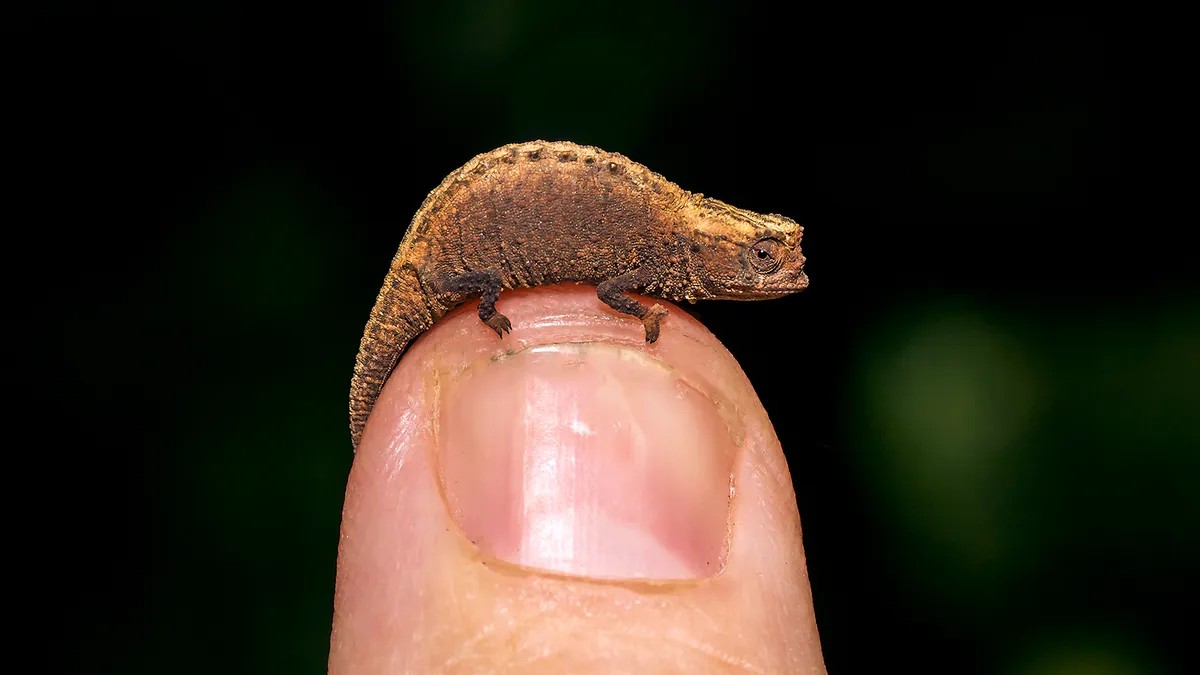
- The Nano Chameleon: The title was recently challenged by Brookesia nana, a tiny chameleon from northern Madagascar. Formally described in 2021, this species boasts an SVL of approximately 12.7 mm (0.5 inches). Because it is a chameleon, its discovery shifted the record-breaking conversation from geckos to an entirely different family of reptiles.
While other small species exist—such as the Virgin Islands dwarf gecko or the Lesser Earless Lizard—the Jaragua gecko and the Nano chameleon sit at the very edge of what is biologically possible for a reptile.
A Fragile Existence: The Cost of Being Small
The extreme miniaturization of these lizards is not just a biological marvel; it is a survival risk. Small size often dictates a very specific, narrow habitat requirement.
For species with a tiny physical footprint, there is very little margin for error.
The habitats these animals rely on are under constant threat:
1. Microclimate Dependency: The Jaragua dwarf gecko requires specific moisture levels found in leaf litter. If the forest canopy is removed, that moisture evaporates, destroying its home.
2. Habitat Fragmentation: Both the Dominican Republic’s dry forests and Madagascar’s rainforests are facing intense pressure from deforestation.
3. The “Hot Spot” Risk: The Caribbean and Madagascar are ecological hotspots, meaning they host high numbers of species found nowhere else on Earth. When deforestation occurs in these regions, we don’t just lose trees; we lose entire, irreplaceable lineages of life.
The Nano chameleon is already considered a candidate for Critically Endangered status due to these habitat losses. This highlights a sobering trend in modern biology: we are often discovering new species at the same time we are witnessing the destruction of the environments they need to survive.
Conclusion
The race to identify the world’s smallest lizard reveals much more than just biological limits; it underscores the extreme vulnerability of specialized species. As habitat loss continues globally, these tiny record-holders serve as a reminder that even the smallest lives can be lost forever if their environments disappear.