Simplicity isn’t always boring. Sometimes it’s just better.
Take the Schlage BE365. It doesn’t ping your phone. It doesn’t track your comings and goings. It just works. Our tester, Cathy, liked it precisely because of that lack of digital noise. Install it, punch in a code, open the door. Done.
We tested eight distinct locks. Some are purely mechanical. Others are hubs for your smart home. The good news? They all kept our doors closed when we wanted them closed and open when we needed entry.
Here is the breakdown. No fluff. Just the facts on which locks survived our testing and which ones didn’t.
Зміст
Schlage BE365 Keypad Deadbolt: The Reliable Classic
Price: Mid-range
Rating: High
This is the lock you buy if you want reliability without a firmware update. The BE365 holds an ANSI Grade 2 and BHMA AAA rating. That puts it solidly in the “very secure residential” category.
The design is tactile. Raised buttons. A physical thumbturn. No glass touchpad that cracks under pressure. Cathy installed it in under twenty minutes. It fits standard door preparations, which saves you from calling a locksmith for weird fittings.
Why You Might Want It
- Battery Life: It runs on a 9V battery. Estimates say two years. That is long.
- Codes: You can program up to 19 unique access codes. Share them with family, house sitters, or cleaners. No fumbling with physical keys.
- Manual Override: If the electronics fail—and batteries do die—you have a traditional key. This isn’t a flaw; it’s a safety net.
- Style: It comes in seven metallic finishes. Camelot trim for traditional homes, Plymouth for rounded looks. It doesn’t look like a piece of computer hardware attached to your front door.
The Drawbacks
There is no Wi-Fi. You can’t check if your kid got home from school. There is no app. If that bothers you, look elsewhere. Also, the battery isn’t rechargeable. You change the 9V cell when it dies.
“Simplicity can make a lock even more secure. Fewer points of failure. Fewer potential intrusion vectors.”
If you don’t need smart features, this lack of them is actually a feature.
Yale Assure Lock SL (Smart Code): The Retrofit Choice
Price: Mid-to-High (depending on hub)
Rating: Very High
Most smart locks replace the entire deadbolt. This Yale model is different. It’s a retrofit.
It keeps your existing exterior deadbolt and cylinder. You just swap out the interior faceplate. Megan, our tester, did this in twenty minutes with a screwdriver. She kept her old keys for the house. That matters.
How It Works
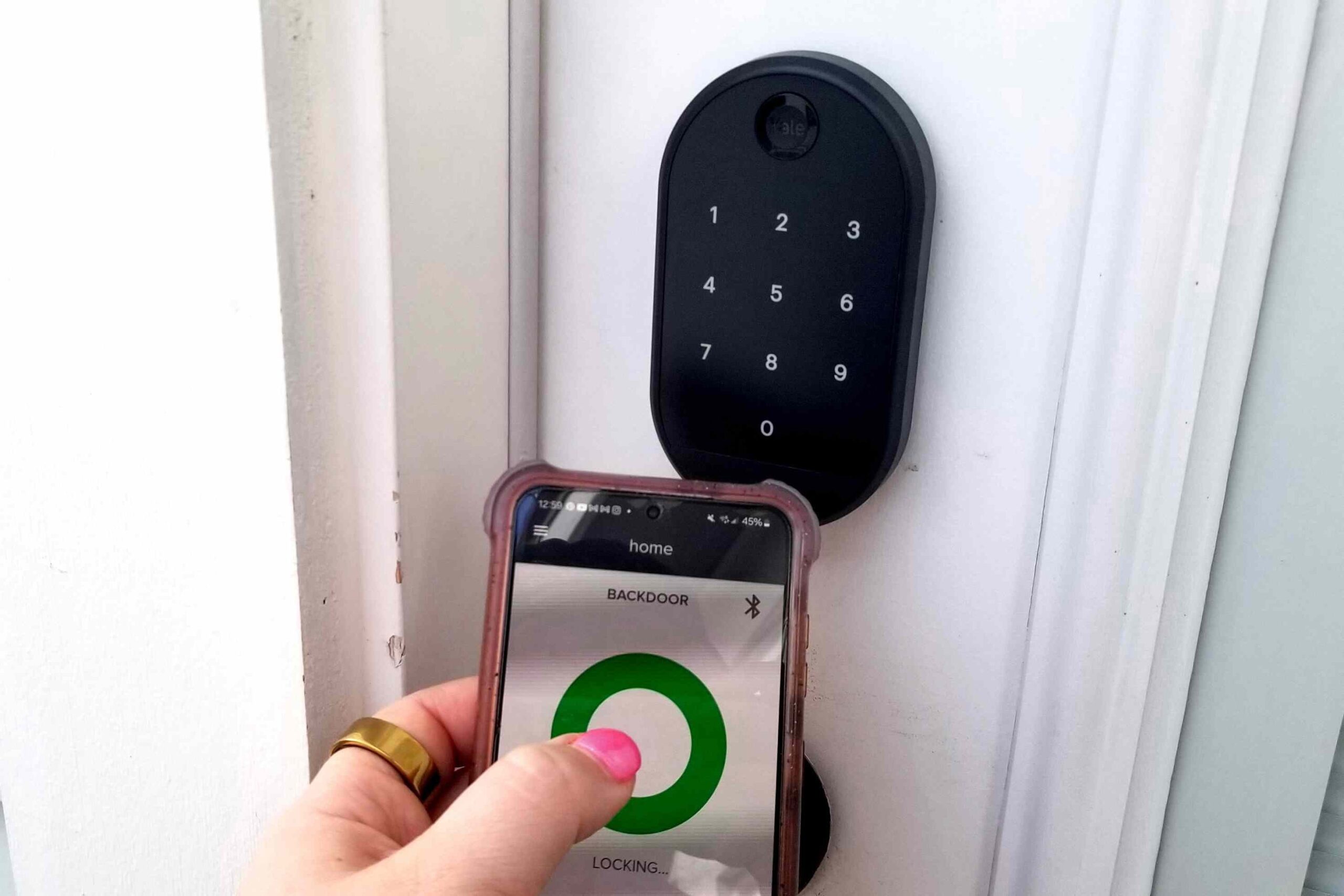
The lock uses a proximity sensor and a Wi-Fi hub (sold separately in some bundles) to communicate with your doorframe. When you walk up, the door recognizes your phone’s location. It unlocks automatically. No tapping codes. No fiddling with keys.
The bundle we tested included a wireless keypad that adheres to the door. It’s smooth. It supports 250 codes. That’s enough for a small army.
The Catch
Fit is everything. Megan found that her door had to be pulled tightly shut to engage the lock properly. If the door doesn’t seat perfectly, the smart features might not trigger as intended. The activity log also lagged sometimes. Data didn’t appear in the app instantly.
Why Choose It?
It’s for the person who wants smart convenience but doesn’t want to throw away their existing hardware setup. It blends into the background. The design is sleek, available in black suede or silver.
“I hate using apps. But I like having the option if needed. The keypad is reliable.”
Kwikset SmartCode 912/917: The Value Pick
Price: Affordable
Rating: Good (with caveats)
Kwikset usually wins on price. This lock is no exception. It offers a lot for the money.
The SmartCode 917 features a lever handle, not just a knob. For some, this is easier to operate, especially if you have something in your hands. The keypad is bright. Easy to read.
Specs
- Battery: 3-year estimate. Better than most.
- Codes: 30 unique codes stored.
- Security: BHMA AAA rated.
- Re-keying: Features Kwikset’s SmartKey technology. Change the lock’s core without taking it apart. Useful if you lose a key or want to reuse an existing key for a different door.
Issues in the Field
Dave, our tester, ran into hardware alignment issues. The bolt hit the strike plate wrong. The lock jammed. It took manual adjustments to fix. Instructions didn’t cover this edge case. If your door frame is slightly out of square, you might have work to do.
Verdict
Good value. Reliable keypad. Long battery life. Just measure your door prep before you buy.
Kwikset Halo Touch: Biometric Entry
Price: Mid-to-High
Rating: High (for tech enthusiasts)
Fingerprints. Finally, they’re practical on the front door.
The Halo Touch uses a fingerprint scanner. You register up to 100 prints for 50 users. Laura set hers up with zero hassle. Her daughter’s print worked too. A quick touch. Door opens.
It also supports geofencing. The door unlocks as you approach. No phone required if you trust the sensors.
The Biometric Advantage
No codes to forget. No keys to lose. For kids, it’s foolproof. For elderly relatives, it’s easier than dials or buttons.
Limitations
No keypad is included. You can buy one separately, but it’s an extra cost. There’s also no built-in handle or knob. You must buy your own trim to match your house style.
Internet access is needed for most smart functions. Laura experienced a Wi-Fi outage during testing. The lock stayed operational on four AA batteries, but the app was useless. If you live in a area with spotty Wi-Fi, this might be a friction point.
“A quick touch of your finger to the circular scanner, and you’re in.”
It’s sleek. Unassuming square panel outside. Larger interior panel with a lever to engage the deadbolt.
Yale Assure Lock 2 with Touchscreen Keypad
Price: Premium
Rating: Excellent
This is the Swiss Army knife of smart locks. It plays nice with everything. Alexa. Google Home. Apple HomeKit. Samsung SmartThings. Philips Hue.
The “Touch” in the name refers to the built-in fingerprint scanner. Yes, it has one. And a touchscreen keypad. And a physical key option (on some models). And geofencing.
Customization
Jodi, our tester, used it to automate her life. In the morning, the door unlocked for the kids and the dog. All day, it stayed locked. At night, she could set it to lock automatically.
You can customize entry methods. Give a neighbor a code that works once. Give your son a fingerprint. Use geofencing for yourself. It hits all the buttons for a tech-forward household.
Trade-offs
It’s bulky. The hardware requires drilling. It’s not a simple drop-in like some others. You’re committing to installation.
The lock is ANSI Grade 2 rated. Solid. Reliable. The finish options are decent, including black suede and oil-rubbed bronze.
“This lock really hits all the buttons for our family’s uses.”
It’s expensive. But if you want every smart feature on one device, it’s worth the investment.
Ultraloq U-Bolt Pro: The Budget Biometric
Price: Under $100 (base model)
Rating: Surprisingly Good
You don’t need to spend hundreds for a fingerprint lock. Ultraloq proved that.
The U-Bolt Pro offers fingerprint, code, and physical key entry. It connects via Bluetooth to the app. You can set it to auto-lock. You can unlock it remotely.
Performance
Mike, our tester, called it the best lock he’d ever used. That’s saying something. He liked the accuracy of the sensor. He liked the reliability of the mechanism.
It carries an ANSI Grade 1 rating. That’s commercial grade. Usually reserved for heavy-use doors in offices. For a home, that’s overkill. And reassuring.
The Catch
The design is stark. Black and silver only. The keypad rings the fingerprint scanner. It looks modern, but maybe too modern for some historic homes.
Also, smart features like remote access require a Wi-Fi bridge (sold separately). The base model is Bluetooth only. If you want to lock the door from work, you need that hub.
Why Buy It?
Price. You get Grade 1 strength, biometric entry, and smart home sync for under $150 with the bridge. It’s hard to beat.
Schlage Encode Smart Lock: The Premium All-In-One
Price: High
Rating: High (if it works)
The Encode is Schlage’s answer to the smart lock war. It has built-in Wi-Fi. No hub needed. It connects directly to your network.
It holds a BHMA AAA rating and an ANSI Grade 1 rating. The mechanical components are backed by a lifetime warranty. Electronics get three years. That confidence comes from a brand with a century of history.
Features
Backlit touch keypad. 100 codes. Entry alarm. Remote control via app. Sync with Google Home and Alexa.
It lacks geofencing, though. Some users view this as a security feature. No accidental unlocks when you’re not home. You have to choose.
Service Issues
Jordan, our tester, had code issues early on. Codes didn’t work. Customer support was slow. Days passed between responses. Eventually, they sent a replacement. The tech is good, but the support process is a weak point.
No handle included. You must buy one separately.
“The best door locks to prevent break-ins still have a strong physical deadbolt at theircore.”
The Encode combines that physical strength with top-tier electronics. It’s just a high-maintenance setup.
Schlage vs. Yale vs. Kwikset
We covered the big three brands. Here is how they stack up.
Schlage
* Pros: Classic design. High security ratings. Trusted reputation.
* Cons: Often more expensive. Smaller smart lock selection compared to Yale.
Yale
* Pros: Innovative retrofit options. Wide smart compatibility. Modern designs.
* Cons: Some models require hubs. Fit can be picky.
Kwikset
* Pros: Budget-friendly. Widely available. User-rekeyable (SmartKey).
* Cons: Slightly lower durability perception (though improving). Biometric models are newer and less mature.
What to Look For
Not all doors are created equal. And not all locks are either.
- Check Your Door Prep. Most locks fit standard US doors. Some require specific backsets or bore holes. Measure before you buy.
- Define Your Needs. Do you need geofencing? A keypad? Biometrics? Or just a reliable deadbolt with code access?
- Consider the Hub. Some locks need a separate hub. That’s an extra cost and another device to plug in. Others have built-in Wi-Fi.
- Battery Type. 9V? AA? AAA? Rechargeable? How often will you want to change them?
The Bottom Line
There is no single “best” lock. There is only the best lock for your door, your budget, and your habits.
Cathy liked the Schlage BE365 for its simplicity. Megan liked the Yale retrofit for its ease of installation. Laura liked the Kwikset Halo for the fingerprint convenience. Mike liked the Ultraloq for the value and Grade 1 strength.
If you want the least maintenance, go mechanical. If you want automation, go smart.
Just make sure the bolt throws deep into the frame. That’s what actually keeps you safe. Technology is nice. Physics is non-negotiable.