July hits hard. The sun beats down, the ground cracks, and your fruit trees look like they’re holding their breath. Most homeowners panic. They grab the hose and dump water everywhere, thinking quantity equals quality. It’s a waste. Water evaporates before it ever helps the roots.
There is a better way. It requires less water, less time, and no heavy lifting. It involves a weekly habit that transforms dry, stressed orchards into lush, productive spaces. You don’t need to be a master horticulturist. You just need to stop fighting the heat and start working with it.
Зміст
Why Soil Moisture Matters More Than Rain
Under the mid-summer sun, every drop counts. When the top inch of soil dries out, trees dig deeper. They stress. The fruit suffers. You get smaller apples, bitter prunes, or worse—premature drop.
Soil moisture is the single biggest factor in fruit quality during heatwaves. It dictates size, flavor, and how long the fruit stays on the tree. If the ground is bone-dry, the tree shuts down production to survive. You can’t just hope for rain in August. You have to help the ground hold onto what it has.
Can You Get More Fruit Without More Water?
It sounds like a myth. We are told to feed the plant, not the soil. But in July, feeding the plant with water alone is inefficient. The goal is conservation.
Instead of losing water to evaporation, you trap it. This isn’t magic. It’s basic physics. You create a barrier that keeps the underground reservoir cool and wet. The result? Vigorous trees that keep producing even when the air temperature spikes.
The Power of Mulch: Compost or Grass Clippings?
The secret to a高产 (high-yield) orchard isn’t in the leaves. It’s in the ground cover. A layer of organic material acts as an insulator. It blocks the sun from baking the root zone. It reduces thermal shock. It feeds the soil biology.
You have two main options for this layer. Each has pros. Each has pitfalls.
Compost
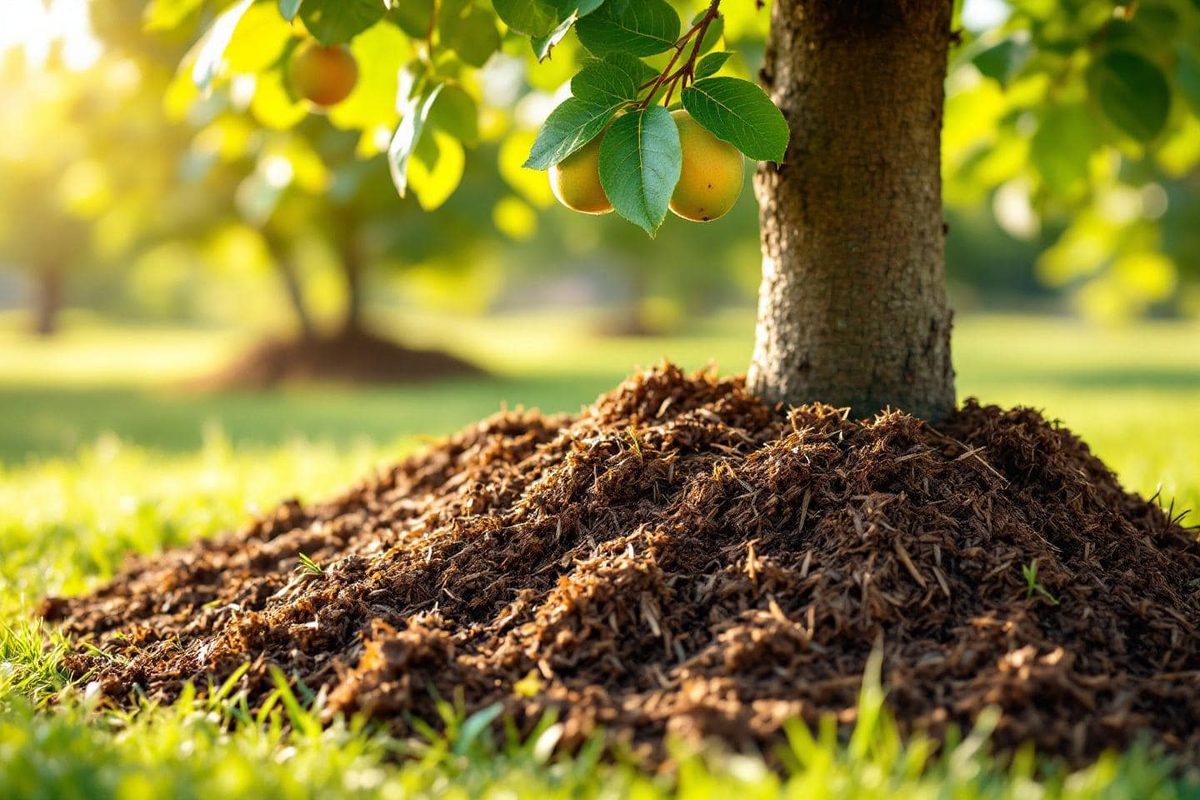
Use mature compost. Fresh compost burns roots. Mature compost adds organic matter and feeds microbes. It is heavy. It is dense. It is best for mature, hungry trees. It improves soil structure over time.
Dried Grass Clippings
These are free. They are everywhere after mowing. But here is the catch: they must be dry. Fresh wet clumps will rot. They will smell. They will mat together and suffocate the soil underneath. Dry clippings break down faster and stay loose. They repel evaporation effectively if spread correctly.
Avoid thick layers of fresh green waste. It creates anaerobic pockets. Your roots need oxygen, not a swamp.
The Weekly Ritual That Changes Everything
This works because it is consistent. Once a week, you walk the orchard. You don’t need special equipment. You just need attention.
- Clear the competition. Lightly weed around the drip line. Grass steals water. Remove the rivals.
- Apply the layer. Spread 2 to 3 cm of mature compost or dry grass clippings.
- Protect the trunk. Leave a few inches of bare soil around the bark. Mulch against the trunk invites rot and pests. You are mulching the root zone, not the tree itself.
- Timing is key. Do this in the cool hours. Early morning or late evening. Or right after a rain. You want the soil damp before you seal it in.
Optimization Tips for Maximum Efficiency
Thickness matters. You want isolation without suffocation. Aim for 3 to 5 cm total coverage. Too thin? The sun wins. Too thick? The soil can’t breathe.
Spread it evenly. Clumpy application creates dry spots and wet pockets. Uniformity ensures every root gets help.
Recycle continuously. Add fallen leaves. Add fine wood chips. Mix it up. Different materials decompose at different rates. This keeps the soil biology diverse and active all season long.
As you stick to this routine, you will notice the hose gathering dust. The water bill drops. The soil stays cool.
The Invisible Army in Your Soil
Mulch does more than hold water. It builds a ecosystem. As the organic matter breaks down, it attracts life.
Earthworms love it. They tunnel through, aerating the soil. Microbes feast on the carbon. Insects help with decomposition. This biological activity creates a sponge-like structure in the dirt. Roots penetrate deeper. They access nutrients that were previously locked away.
The tree absorbs water more efficiently. It doesn’t have to fight for every drop. It drinks deeply.
Signs You’re Doing It Right
You don’t need to wait until harvest to know this is working. Look at your orchard now.
- The soil feels cool. Even at noon. Even when the air is hot.
- The leaves are deep green. No yellowing. No wilting at midday.
- The fruit is setting. More buds are turning into small fruits. The caliper is increasing.
These are signs of a healthy, hydrated root system. The tree is not in survival mode. It is in growth mode.
Keep the layer fresh. Add to it as it decomposes. The work is simple. The payoff is massive.
But what happens when the first frost hits? That is when the real test begins. How do you protect those established roots when the ground freezes? We will cover winter prep in the next step. For now, keep the mulch fresh and the weeds out.
The weekly habit that saves water and boosts harvests
Stop waiting for the perfect rain. Start with a shovel.
Across France, gardeners are ditching the hose for a simpler trick. The result? Trees that shrug off drought and orchards that actually produce fruit. The secret isn’t a complex chemical mix. It’s routine. Specifically, adding a fresh layer of mature compost or dry grass clippings around the base of your fruit trees every single week.
It’s hard to beat that for ecology. Or economics. You’re basically turning waste into gold.
Why this works when summer hits hard
Most people mulch once in spring. That’s not enough. The key is consistency. By adding material weekly, you maintain moisture retention exactly when the sun is beating down hardest.
The soil stays cool. The roots stay hydrated. You stop walking around with a watering can like a martyr.
Small tweaks for bigger returns
If you want to push this further, mix up your materials. Don’t just use grass.
- Alternate your layers. Use dry grass, then leaves. Then wood chips. This diversity feeds different soil microbes. A balanced ecosystem is a resilient one.
- Plant companion flowers. Bring in pollinators. Ladybugs. Predatory insects that eat the pests you don’t want. Your orchard becomes a habitat, not just a factory.
- Install rain barrels. Save every drop. But here’s the catch: only water if you have to. The mulch should do the heavy lifting.
The payoff
Your orchard transforms. It stops being a chore list and starts being a living system.
Resilience against summer heat isn’t magic. It’s maintenance. It’s the discipline to drag that compost bin out every seven days.
Do it long enough and you won’t just survive the heatwaves. You’ll thrive in them. The harvest will be heavier. The water bill lighter.
It’s a habit. And once you see the results, you won’t stop.